no technological unconscious.
In which Eric Mullis shares a new version of his Motive Forces project and I fall even further into technophobic hyperbole.

Choreographer Eric Mullis is a notorious tinkerer, producing seemingly endless variations on his work. His last major project, Later Rain, started as a weekly trance induction workshop, eventually became a piece of performance/ethnography about Pentecostal church communities in the rural south and toured for nearly a decade, continually mutating. Later Rain incorporated a live band, a sermon, and sequences of dance performed solo and in chorus. The only thing missing was an altar call.
These days he’s exploring different cultic phenomena with his Motive Forces project. At this point, well into the piece’s development, different versions have appeared locally at Goodyear Arts, The Mint Museum Uptown, and (quite spectacularly) in the vast and historically complicated Ford Building at Camp North End. Selections have toured to Durham and Black Mountain as well as Detroit and Tempe. On January 12th I saw the most recent iteration. And that’s what we’re here to talk about.
For reasons which remain obscure to me the performance took place at two locations. There was supposed to be a third, I’m told, but scheduling issues took the stopover intermission at NoDa’s Free Range Brewery out of the mix. (Ok so, I wasn’t completely non-plussed by the movement between spaces, as every version of this piece I’ve seen has had an element of the promenade to it. This is an extreme case though. I had to drive somewhere else!)
Act One was performed at Caldwell Presbyterian Church in Elizabeth, near the hospital. This first section showcases the historic building’s newly renovated Hope Hall with its clean lines and high ceilings. It’s a good room. A little on the beige side but the windows are glorious.
The audience was about what you’d expect for an experimental dance event: friends and family, ex-girlfriends, artsy types, fartsy types, and funders checking in to make sure that the thing is actually happening. The vibe is very “church potluck in an upperwardly mobile suburb of Atlanta.” I mean that in a nice way?
Things kicked off with a short set of ballads performed by composer-performer-psych folk siren Kadey Ballard. Ballard’s inclusion in the evening is a given. A prominent veteran of Later Rain, her voice and looped tonal compositions have appeared in most versions of this current project as well. What was strange, in the context of the event, was the emotional tenor of Ballard’s performance. Her reliably expressive voice crooned and sighed, weaving into and alongside dreamy, lachrymose guitar feedback. It was an interesting way to start an evening that would move further and further away from the emotional, indeed further and further away from the human.
The central concern of the Motive Forces project is the relationship between man and technology. It’s been framed since its inception as a sort of R&D proposal, a lab for Mullis to experiment with gear, techniques and approaches to integrating dance and technology. In his opening speech at Caldwell Presbyterian he alluded to this particular version being a little more lo-fi than others. The main technological element at play here was a motion visualization technology that allowed him to record improvisations, manipulate that footage and then put the amended movement back onto the dancers. Throughout the program I noted choreographic flourishes that recreated, or alluded to, the idiosyncrasies and glitches of video.
After Mullis’ welcome we were plunged into darkness and Point Cloud I lurched gurgling into action with the moan of automated shades descending to cover the space’s floor-to-ceiling windows. In the dark the sound was sinister; a strong, theatrical opening to the proceedings. Apart from this bold gesture, the design elements in this section were sparse, homey and warm. This was the most human work I saw all night, both in terms of the performance and the degree of technology employed onstage. Joy Davis, in minimalist black, danced solo in a central clearing delineated by small groves of lighting trees which anchored the corners of the room at the cardinal directions. Bathing the action in a warm glow, their slender forms were evocative of Giacometti’s sculptural work or the pathetic tree under which Beckett’s tramps waited for Godot. They were a nice touch, gesturing to the abstraction of high modernism, whose mid 20th century luminaries (I’m thinking specifically of Cunningham and Cage) have been guiding lights for Mullis in his own artistic journey.
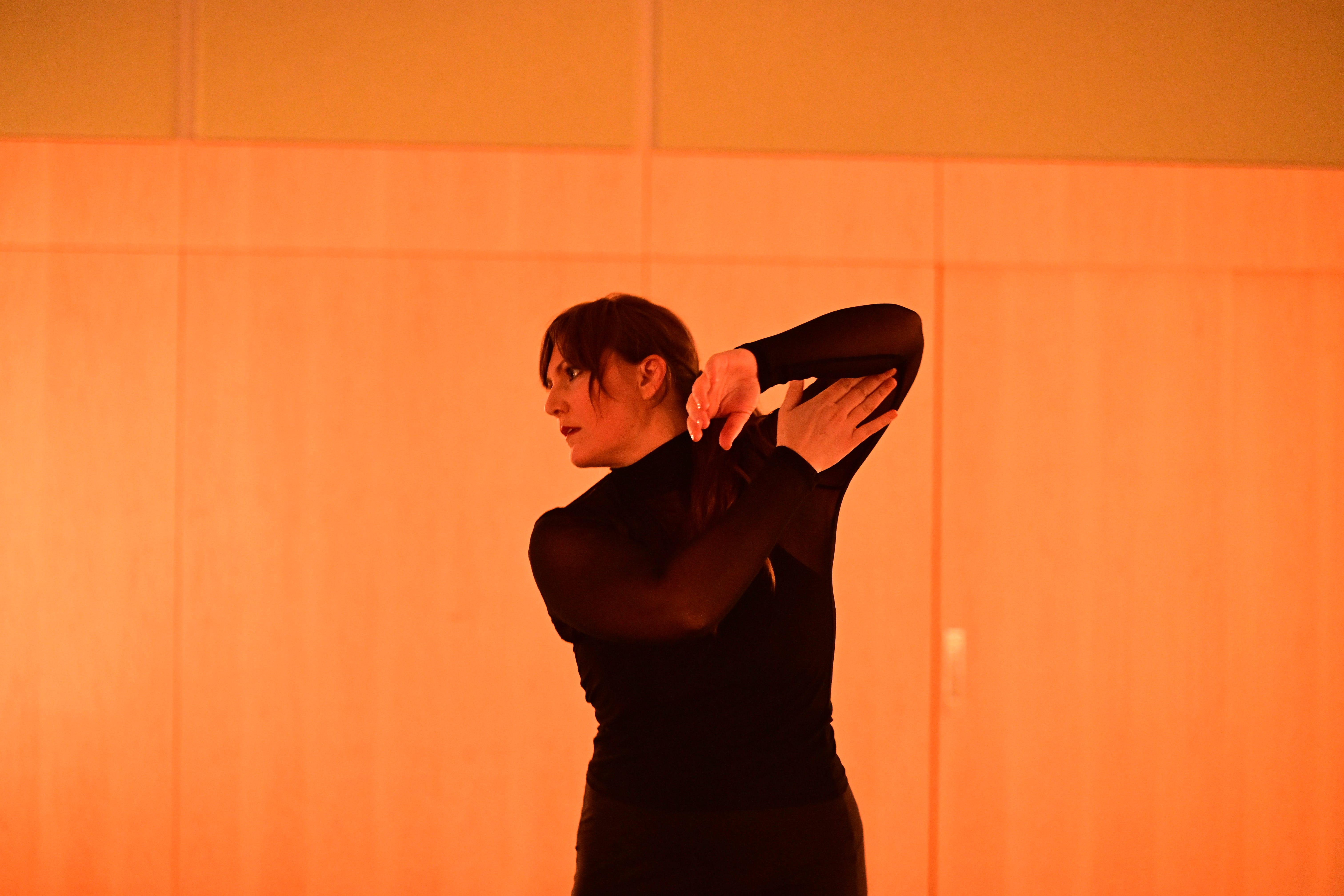
Joy Davis in Point Cloud I. Photo By Steven Pilker
Point Cloud I’s movement started in a close up, Davis rigid; absolutely still except for curious, sharp adjustments of her head and neck. Her eyes were avid and attentive. It was disconcerting and a bit bizarre but not out of place, especially coming hot on the heels of the mechanical groans which began the dance. Soon enough the stillness melted and the movement expanded. Davis measured the space; like she was sizing up an opponent, the measurement itself a sort of attack. Or violation. That old saw that observation changes the thing observed felt viscerally true. As a performer Davis is confident balancing precision and ease, knowing when to apply weight, gravity and drama and when to let go, shrugging something off and moving on. Her movement in this piece was muscular and incredibly grounded, but at regular intervals there were lighter than air leaps, and these balletic interjections subtly historicized the proceedings. Much as the lighting felt like a nod to Black Mountain College experimentation, these echos of Balanchine continued to signal an overall alignment with the modernist project, it’s embrace of abstraction and playful formalism. And while the movement here is emphatically abstract, Davis operated without preciousness or artifice, but rather frankness and crystalline clarity such that the abstraction was tempered. There was a human in the room and she was having an experience, suspended and swinging between tension and release, between earth and sky. An experience we bore witness to.
After Point Cloud I, the evening’s performances have a different quality: decidedly chilly, sometimes bordering on vacant. Instancing Network, which closes out the Caldwell Presbyterian portion of the evening, is a duet danced by Madeline Badgett and Taylor Railton. The duo are stone faced, clad in white bodysuits that soak up the saturated greens and purples of the lighting design. Buffeted by sound that is an uneasy marriage of dreamscape and percussive nightmare, things feel much more firmly situated in the world of capital “T” Technology at this point.
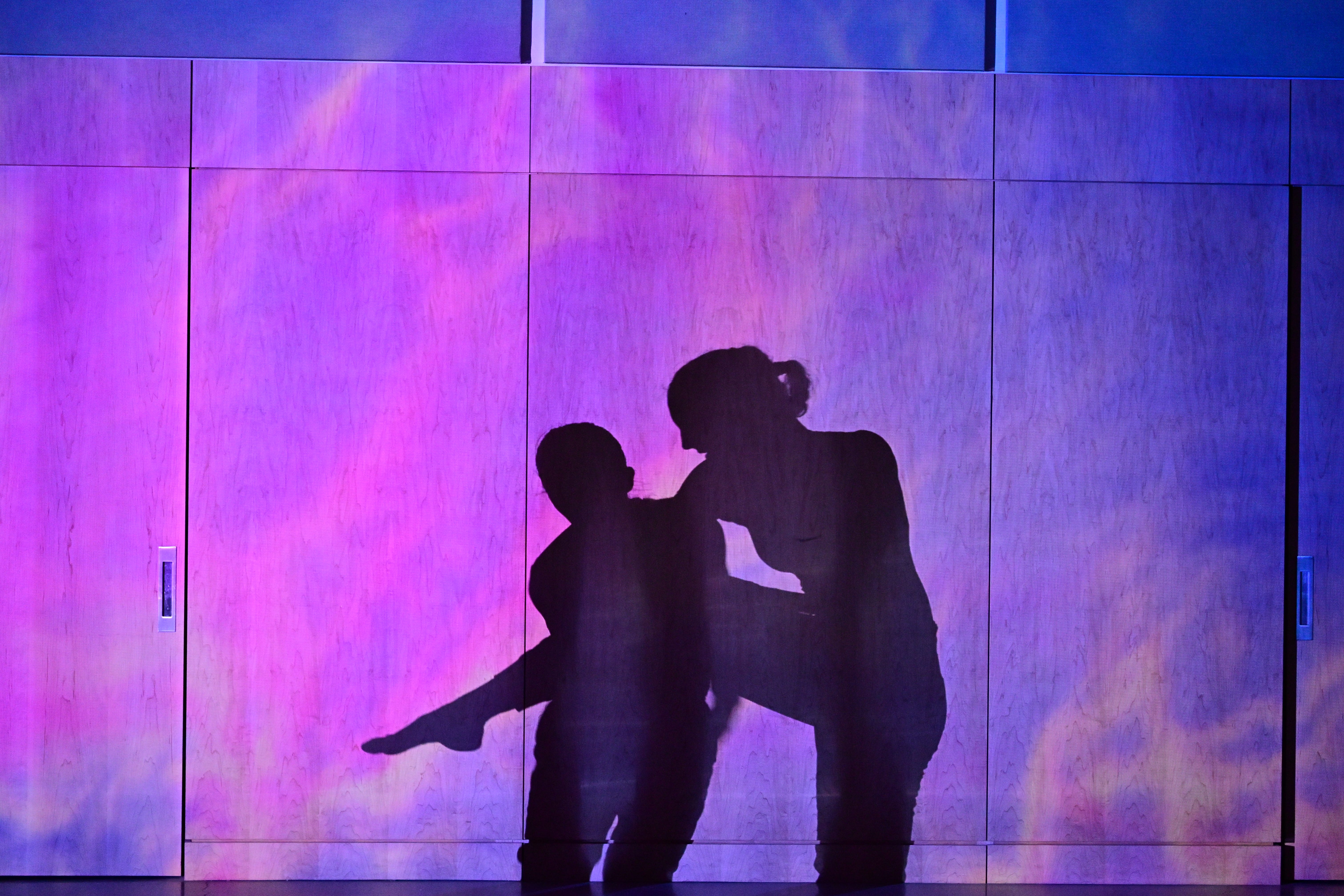
Madeline Badgett and Taylor Railton in Instancing Network. Photo by Steven Pilker
Much of what was strongest in Instancing Network played with extremes. Railton began the piece dancing solo, and then I must have blinked because suddenly there were two bodies where a moment before only one had moved through the space. It seemed to me that Railton had split in two, dividing like a cell. The effect was startling. While I didn’t perceive a tremendous difference in the choreography between Point Cloud I and Instancing Network there was a noticeable shift in the dancer’s tone and affect. I felt ever more distant from what I’m watching. Railton and Badgett were used most effectively when covering big swathes of space at high speed, or locked in to moments that seemed particularly demanding athletically. The strain forced them to engage with their discomfort and keep things at least a little bit human.
For the second part of the evening we headed to Camp North End. This is where the stop over at Free Range had been planned initially and it’s interesting to consider that it’s at this point in the evening that Ballard was intended to have played. At Goodyear Arts there was a brief pause for Mullis and crew to set up the space, during which time I ate some shawarma from the Halal joint across the street. I bet you were wondering about that.
Act Two began with Facets, which sees the return of Badgett and Railton joined by Luke Csordas. The trio were clad in shades of red and pink, and their bodysuits, rich color notwithstanding, continued the relative overall utilitarian invisibility of the costumes in Motive Forces. Other design elements, however, began to insist on themselves more urgently in this portion of the evening. A composition of resonate and magisterial brass was riven through with tinny bells and the occasional clip of human speech. A hazer was used to fine effect, fracturing a broad shaft of light, bright and white, into a myriad of beams. The overall effect of sound and light mediated by haze in the warehouse mileaux of Goodyear evoked the sort of post-industrial Heaven you might find in one of Derek Jarman’s early films.
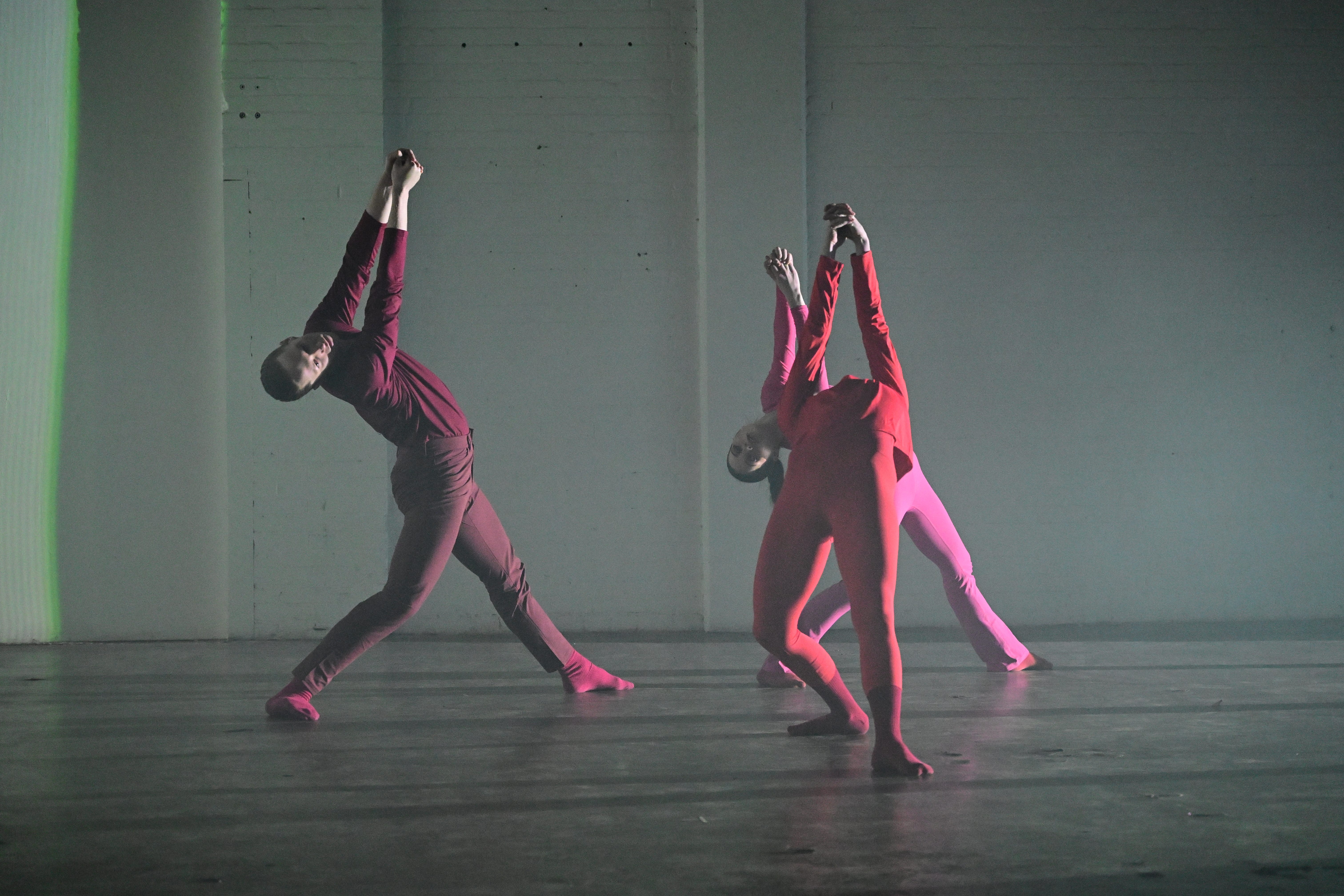
Badgett, Csordas and Railton in Facets. Photo by Steven Pilker
Perhaps it was my distended and disorienting vantage point at Goodyear compared to the intimacy of Hope Hall, or the dynamism inherent in the triangular relationship, but I found Facets to be the most formally exciting, riskiest work of the evening. As with Instancing Network, this trio was most compelling when creating extreme visual echo effects, working at a clipped pace and in close proximity to each other. It was striking that there were sections of Facets that felt disconcertingly loose for an artist as fastidious as Dr. Mullis. Riots of tempestuous canon just beginning to edge into messiness cohered into beautiful bits of physical melody, emerging momentarily as a sort of spectral order revealed from within chaos. There was an extended moment of stillness at one point that was perhaps the boldest choreographic stance made by Mullis in the entire evening, a stunning proof that with dance stillness is as important as action.
The audience picked up our chairs and turned a literal corner for the final portion of the night, and were confronted by the most extreme scenic element of the evening sliding us to the other edge of an emotional spectrum that we started traversing back at Caldwell Presbyterian. Here at the end of the world, frozen sprays of blue electricity were rear projected onto ragged sheets of diaphanous plastic suspended from the high ceiling. The sound that filled the room was a distended pulse. Fans artificial wind played upon and around the projection surfaces which rippled, flapped and curled creating an uneasy and uncanny approximation of life. It’s unsettling and gorgeous. It is in this setting that Amil Brothers performed Point Cloud II with remarkable poise and fluidity.
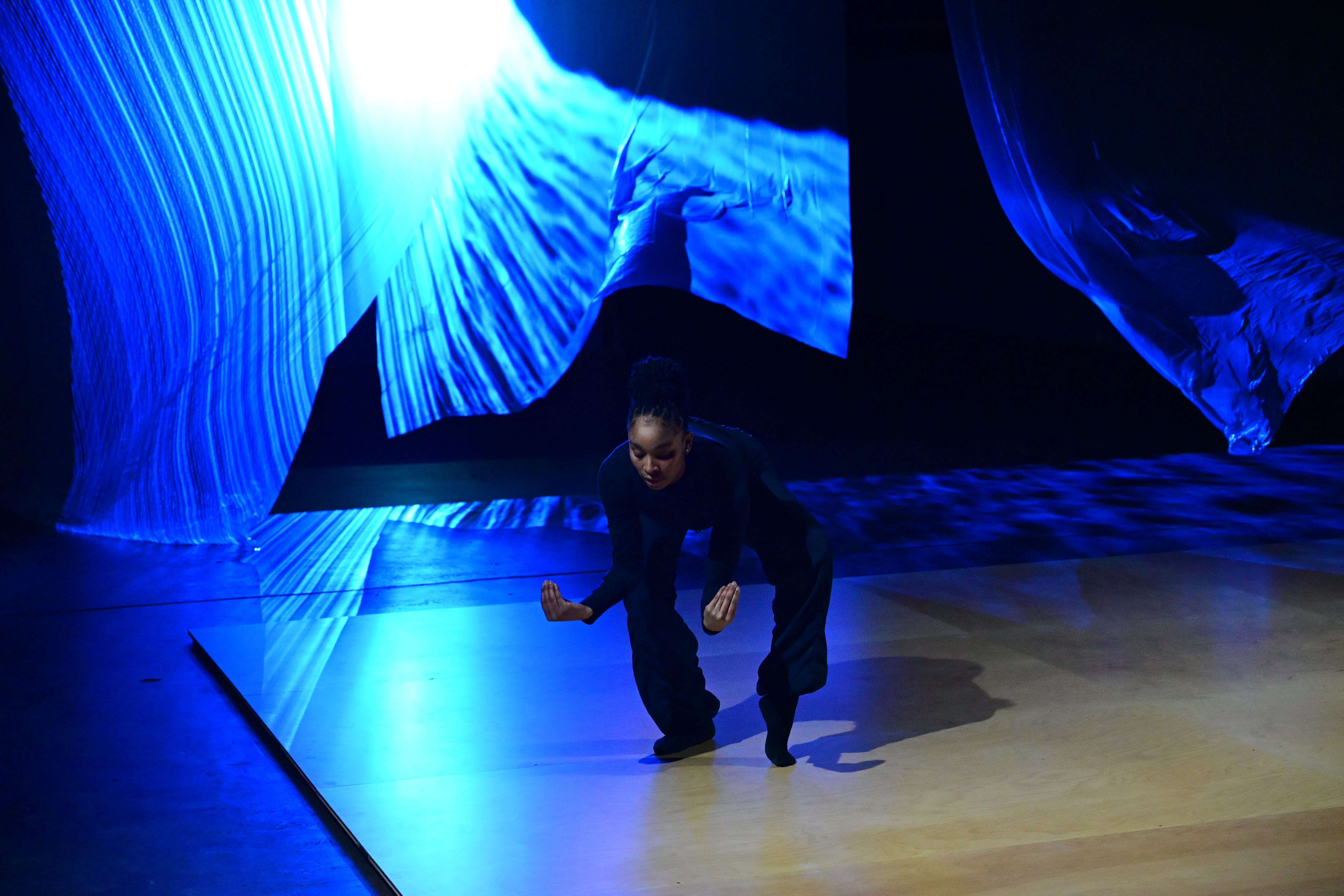
Amil Brothers in Point Cloud II. Photo by Steven Pilker.
Brothers was consistently plugged in and experiencing something. When she threw herself into quick turns I went all breathless and wanted to cheer. These were moments where it felt like Brothers was allowed to cut loose and really go for it, working at a tempo and rhythm that really work for this movement.
At one point Mullis, sitting in the audience operating projection software, began to slap time on his legs. What a lovely moment of contrast: one body spinning in space while another body beats time, framed by projected images of raw elemental power and its effects. A stark dialectic between old and new. This could easily be the moment wherein Motive Forces comes full circle back towards humanity. Instead we rush headlong into the most striking, and certainly the most troubling moment of the evening.
Appropriately, given the night’s trajectory, this final sequence didn't feature any live dancers, only light and sound and digital video. The dance floor was empty while 360 degree imaging of a dancer was projected onto the shredded and dangling screen. An utterly inhuman moment, in which an image of a human being morphs and dissolves; finally breaking down into particles, swimming in the ether. Here are the consequences waiting for us at the end of the Anthropocene: the human being captured, decontextualized and rendered incorporeal, unreal.
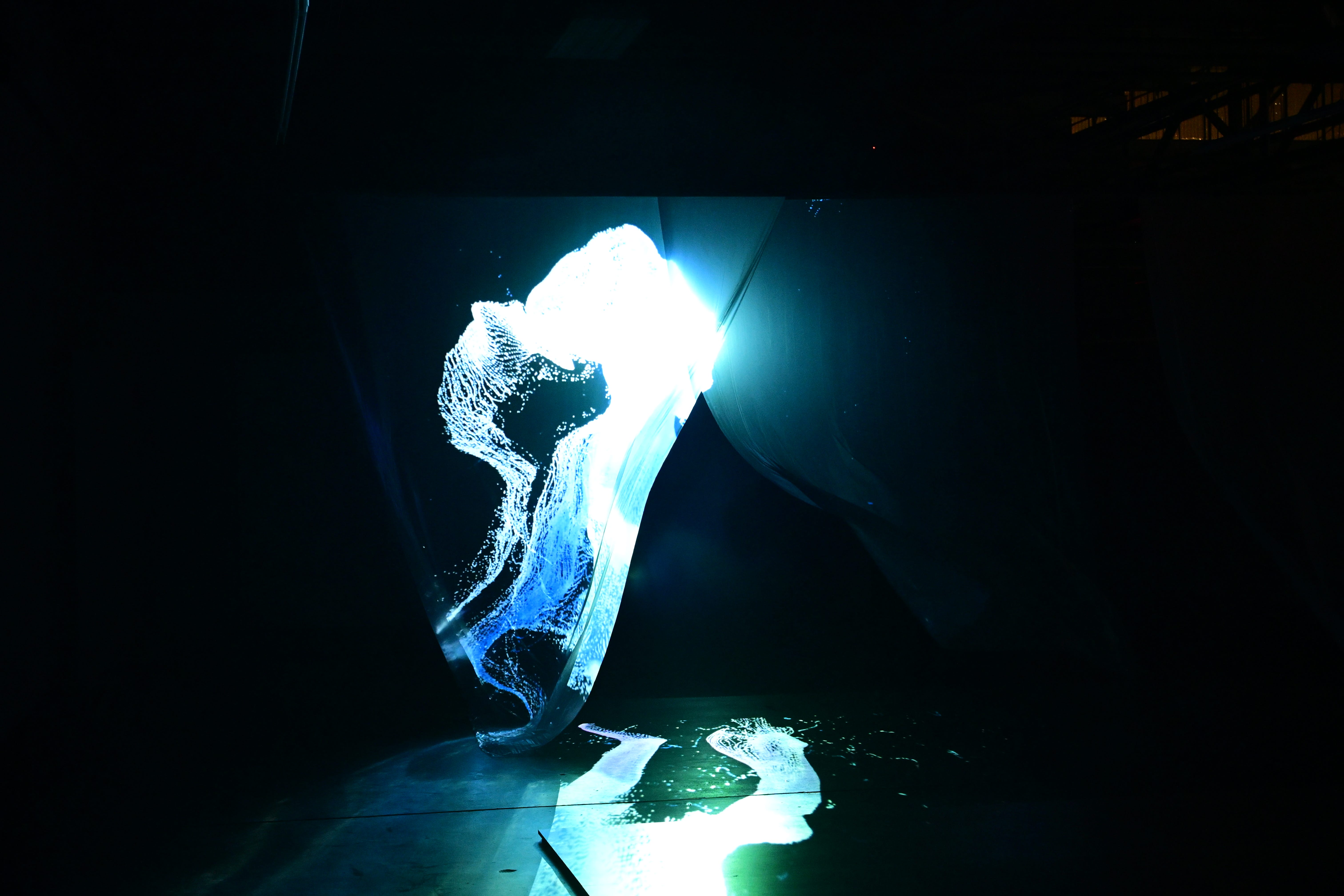
Motive Forces. Image by Steven Pilker.
Aesthetically the effect is striking, but the ramifications give me pause.
I am curious about Mullis’s interpretation of those final moments of Motive Forces. Is there something transcendent implied? Or does he see the same horror and dissolution that I did?
As an experiment with available technology’s applications in making Dance Motive Forces is a successful and pertinent addition to the research. What’s truly interesting about the project though, is the way it problematizes our relationship with technology as a tool and with technology's narratives of progress, and by extension—perfection.
Right now we are living in a moment where a vast industry has sprung up pushing that vision. We’ve long been in thrall culturally to novelty and now that tendency is metastasizing into something uglier. So called Artificial Intelligence is the obvious example. The pitch for AI is an appeal to perfection (by way of convenience.) and people are buying it. This will have disastrous consequences for the human mind and imagination. But perhaps most gallingly it is a grave misreading of what is even important about human activity.
Recently in an interview literary critic Ryan Ruby said something to the effect of “a work of art is not an object, it is a social relation, and without the context implied by any relationship, the work of art is meaningless.” That’s a paraphrase but a pretty good one and it speaks very directly to what is best or more interesting about Motive Forces.
It’s fun to see a talented designer like Mullis play with technology. That’s undeniable. But Motive Forces is a work of art, not a trade show display. And it functions as art because of the messier moments in Facets or the athleticism of Instancing Network. It functions as art because of the depth of Brothers’ presence and the warm physical intelligence of a master performer like Davis. Or, (tip of the hat to Cunningham and Cage’s experiments with chance operations at Black Mountain College) it functions as art because of the weather problems that caused a rescheduling which put Ballard’s musical performance at the beginning of the night instead of in the middle, which altered the overall feel of the night.
Just as important as context (and for that matter craft) is the presence of the blindspot, the flaw, the unintended repetition. This is where the unconscious insists upon itself, breaking through into the work of art. The most impactful technological element in Motive Forces, that awful final moment, filled me with horror and revulsion because it was exceptionally beautiful but ultimately dead. Conversely, the performative moments that have stuck with me were rich with humanity, warmth and life; riding the line between accident, discovery and craft.